
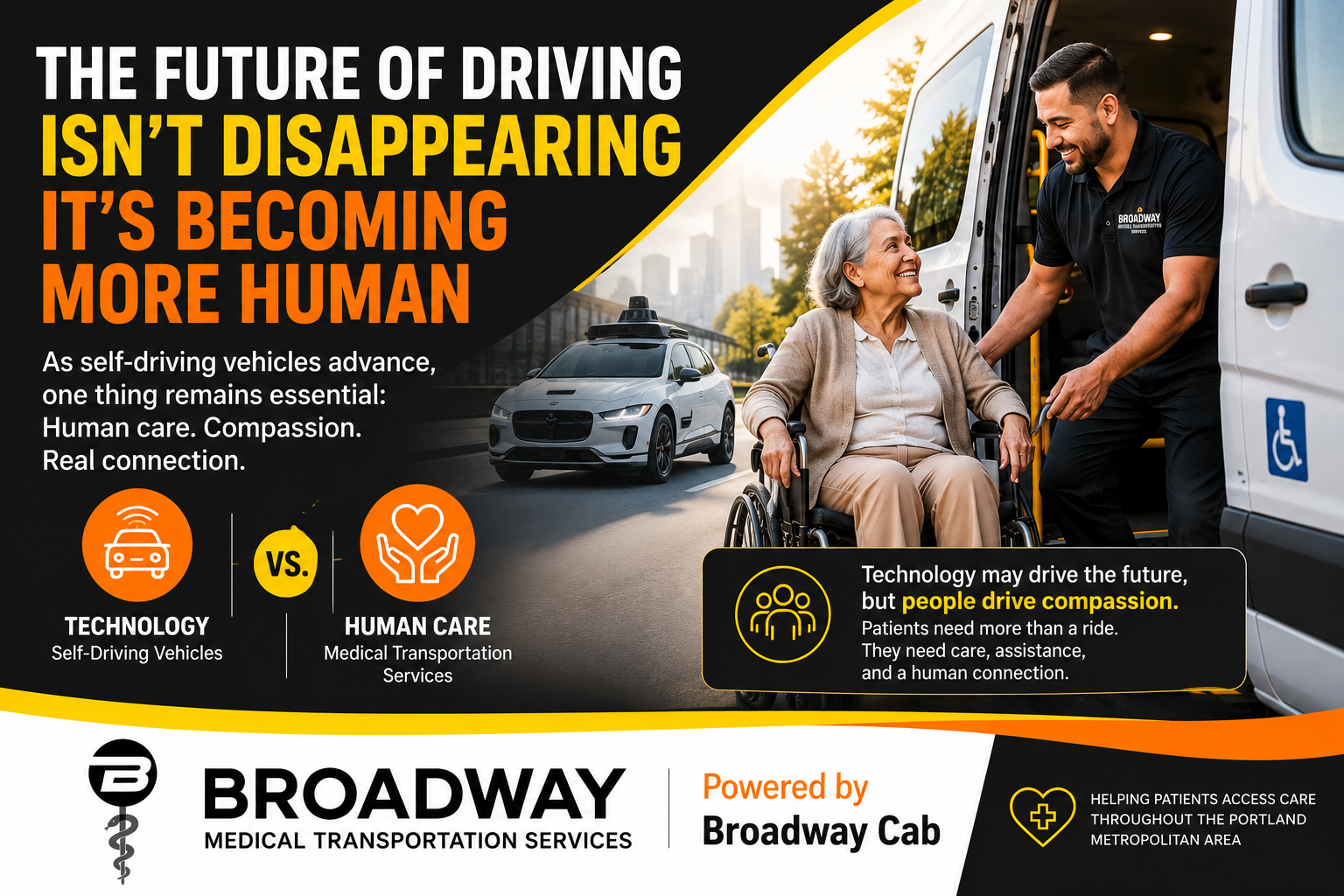
The Future of Driving Isn’t Medical Transport Services: Why Human Care Still Matters in an Autonomous Future
Broadway Medical Transportation Services
Powered by Broadway Cab
For more than a century, professional drivers have helped people get where they need to go. From horse-drawn carriages to taxicabs, airport transportation, and now app-based rideshare services, transportation has constantly evolved.
Today, another major shift is underway.
Self-driving vehicle companies like Waymo are expanding into cities across the United States, including the Pacific Northwest. While the long-term impact of autonomous vehicles is still being debated, one thing is becoming increasingly clear: many traditional transportation jobs will continue to change as automation grows.
For drivers who make their living transporting passengers, that reality raises an important question:
What comes next?
At Broadway Medical Transportation Services, we believe the future belongs to transportation professionals who provide something technology cannot easily replace human care, compassion, and assistance.
The Difference Between Transportation and Care
A self-driving vehicle can transport a passenger from Point A to Point B.
What it cannot do is help an elderly patient safely enter a vehicle.
It cannot secure a wheelchair.
It cannot assist a patient recovering from surgery.
It cannot recognize when a rider is confused, anxious, or in need of additional support.
It cannot walk a vulnerable passenger to the entrance of a medical facility or provide reassurance during a difficult day.
Medical transportation is about far more than driving.
It is about serving people.
Every day, Broadway Medical Transportation Services helps patients travel to dialysis appointments, rehabilitation facilities, hospitals, medical specialists, assisted living communities, and healthcare providers throughout the Portland metropolitan area.
Many of these passengers depend on reliable transportation to receive life-sustaining care.
That responsibility requires a human touch.
Why Medical Transportation Matters More Than Ever
Federal regulators, disability advocates, and transportation providers continue to debate how autonomous vehicle technology should serve individuals with disabilities and mobility challenges.
The National Highway Traffic Safety Administration (NHTSA) has repeatedly stated that automated vehicle technology has the potential to increase mobility for older adults and people with disabilities. However, accessibility and implementation challenges remain under active discussion.
Even Waymo’s current wheelchair-accessible transportation program relies on human-operated accessible vehicles and drivers who assist riders entering and exiting vehicles, securing wheelchairs, and providing support throughout the transportation process.
In other words, even some of the world’s most advanced autonomous transportation companies still rely on trained human professionals when serving passengers with significant mobility needs.
The Regulatory Landscape Is Still Evolving
Autonomous vehicle technology continues to expand, but lawmakers and regulators are still working through major questions involving safety, accessibility, liability, and disability access.
The U.S. Department of Transportation and NHTSA introduced updated automated vehicle frameworks in 2025 aimed at expanding commercial deployment while continuing oversight of safety standards. Policymakers are also examining how autonomous transportation systems can better serve people with disabilities and comply with accessibility requirements.
At the same time, recent investigations and recalls involving autonomous vehicle systems demonstrate that the technology remains under active development and regulatory review.
For drivers considering their long-term career path, this creates an opportunity.
Rather than competing directly with automation, many transportation professionals are choosing to move into specialized services where human interaction remains essential.
A New Career Path for Professional Drivers
Broadway Medical Transportation Services was built for drivers who want to be part of the future of transportation.
Our drivers are not traditional taxi drivers.
They are transportation professionals who help patients access healthcare safely and reliably.
They provide service that requires patience, professionalism, compassion, and trust.
Most importantly, they perform work that cannot be reduced to simply moving a vehicle down the road.
As transportation technology evolves, healthcare transportation continues to require people who care about the individuals sitting behind them.
The Future Is Human
The transportation industry will continue to change according to history.
Technology will continue to advance.
Autonomous vehicles will likely become part of everyday life in many communities.
But healthcare transportation remains fundamentally human.
Patients still need assistance.
Families still need peace of mind.
Healthcare providers still need reliable transportation partners.
And communities still need compassionate professionals who show up every day to help people receive the care they need.
That is why Broadway Medical Transportation Services exists.
Not to compete with technology.
To provide the human connection that technology cannot replace.
Broadway Medical Transportation Services
Powered by Broadway Cab
Helping Patients Access Care Throughout the Portland Metropolitan Area
We care about patients, and providing a long-term career path for transportation professionals.


